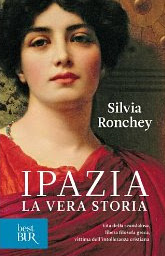
Ronchey, S. Ipazia. La vera storia. 5th ed. Milan: Best BUR, 2013.
This work reconstructs Hypatia’s existential and intellectual life and her modern Nachleben through the application of rigorous scholarly documentation (see the appendix “Annotated documentation,” a sort of “work within a work,” equal in breadth to the primary work) in a text addressed to a learned, non-specialist readership, as well as university teachers and students. The intentionally provocative title relates to the contemporary historiographical notion of “false story,” as does the overall conceptual and methodological treatment. In the first section (Clarifying the facts) the author collates and applies philological analysis to the most important information on Hypatia’s life and death gleaned from all available ancient, Pagan, and Christian sources. Originally, two versions – Pagan and Christian – of Hypatia’s assassination must have co-existed, both available in two variants, one moderate, one radical. In the three centuries between the events and the evolution of the Byzantine historical tradition proper after the Arab conquest, one of the Christian narrations, John of Nikiu’s Chronicle, itself derived from an older, notably pro-Cyril vernacular version within the Coptic church, was lost to the West and preserved only in the Eastern tradition in a late Ethiopian version. The more moderate Christian version, eschewed by dominant Western ecclesiastical opinion, is by Socrates Scholasticus, whose History regarding the case in question probably conforms to the point of view of the central Byzantine church. Suidas passed down both of the Pagan narrations - of Hesychius of Miletus and Damascius. In addition, the version by Philostorgius, an Arian and as such anti-Cyril, whose text is preserved in numerous fragments from Photius’ Library, was appended to Damascius’ variant of the Pagan version from the beginning of the manuscript tradition. From another traditional Byzantine current would seem to be derived, at the time of Justinian, the Chronicle of John Malalas, close to the court clergy and especially to the Church of Antiochia, traditionally at odds with the Church of Alexandria. The account offered by Malalas isolates Cyril, as does Socrates, as prime instigator of and morally responsible for the assassination, but Malalas probably draws on his own sources, in agreement with Socrates on the bishop’s guilt but aware of details lacking in the Socrates as well as the Suidas-Damascius accounts. The most well-known version in Byzantium would remain Socrates’: Orthodox Christian, more cautious than the Pagan and Arian-Christian accounts and slightly different from the one Malalas draws on, but equally anti-Cyril. The same orientation would emanate from subsequent Byzantine sources, which, however, would gradually add useful features from Pagan sources. From 5th and 6th century information, influence, and manuscript tradition, which appears more ramified than generally thought, derives during iconoclasm, the succinct mention of the assassination in Theophanes’ Chronicle; in the 9th century, Photius, clearly believing in Cyril’s guilt, recoups Damascius as well as Philostorgius; in the 10th century, Suidas recoups at least Damascius and Hesychius; in the 14th century, Nikephoros Kallistos Xanthopoulos draws directly on Socrates Scholasticus. From examination of these sources, together with other contemporary evidence, as well as Synesius’ Epistolary, a complex picture of the tensions and social and political conflicts in 4th to 5th century Alexandria emerges, which makes it impossible to reduce the issue of Hypatia’s assassination to a clash between Paganism and Christianity. However, precisely this ideological simplification, this polarity between Hypatia “martyr” and Cyril “bishop-executioner,” has dominated European thought for so long. The second section of the work (Betraying the facts) is devoted to the afterlife of the figure of Hypatia, modernised, mystified, in any case transformed, according to the period, cultural and religious currents, sometime secular icon, romantic heroine, even Christian martyr. But perhaps even more revealing for the history of political thought has been the reception of the figure of Cyril. If ecclesiastical authority tended to interfere constantly in the jurisdiction of the prefect Orestes and the Roman-Constantinopolitan central government – the very erosion of state power by the Church dreaded by the Alexandrian aristocracy (Pagan as well as moderate Christian) of which Hypatia was a spokesperson -, the conviction or exaltation of the feared bishop is a litmus test of the position that every historian or literary interpreter assumes with respect to relations between Church and State. This from the first ancient sources and then during Hypatia’s entire historiographical afterlife: from the Counter-Reformation, which would even discredit a primary source like Socrates Scholasticus to save Cyril, up until Masonic and post-Risorgimento literature, when the fabrication of Hypatia as a secular icon would be interwoven with the debate concerning papal temporal authority. The third section (Interpreting the facts) responds to the more or less conscious distortions that have accumulated over the centuries. Hypatia was not a “secular martyr,” nor a “Galileo in a skirt” punished by the Church for her scientific discoveries, let alone a proto-feminist icon. If it is true that the conflict she found herself involved in – eternal, and cutting across the very same Pagan upper classes, in large part Christianised, especially after the Theodosian Decrees - was between fundamentalism and moderation, dogmatism and open-mindedness, it is also true that Hypatia was a charismatic, priestly figure, a mentor of consciences and an “initiator” in the esoteric teachings of Platonism: a “woman-philosopher,” as long as we understand philosophia as that particular relationship between the female and the sphere of the sacred, of the super-rational, that is typical of the spirituality of Late Antiquity. Hypatia is the emblem of the intellectual fervour of the “eclectic” Platonism that dominated 5th century Alexandria and continued after her “martyrdom,” and was indeed the prerequisite and threshold for a flourishing that would continue for the entire Byzantine millennium.
REVIEWS
E. Cantarella in Reset (January/February 2011)
F. Cardini in Il sole 24 ore (January 23, 2011)
M. Neri in Hiram (January 1, 2011)
A. M. Gasca The Mathematical Intelligencer (July 19, 2014)
Keywords
- Classical philology
- Greek philology
- Philology of Late Antiquity
- Byzantine philology
- History of Late Antiquity
- Byzantine history
- Source exegesis
- Byzantine civilisation
- Ancient philosophy
- Byzantine philosophy
- History of Christianity
- History of the Church
- Martyrology
- Christian martyrdom
- Pagan martyrdom
- History of scholarship
- History of influence or reception
- Nachleben/Afterlife
- False history
- True history
- Hypatia
- Alexandria
- St. Cyril of Alesandria
- Synesius of Cyrene
- John of Nikiu
- Socrates Scholasticus
- Damascius
- Hesychius of Miletus
- Philostorgius
- John Malalas
- Photius
- Theophanes
- Suida
- Nikephoros Kallistos Xanthopoulos
- Relations between Church and State
- Counter-Reformation
- Modernismo cattolico
- Freemasonry
- Feminism
- “woman-philosopher”
- Ancient Platonism
- Byzantine Platonism
- Paganism
- Ancient astronomy
- Astrology
- Theurgy
- Magic
- Alchemy
- Esotericism
- Female priesthood