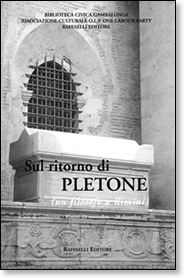
Ronchey, S. “Giorgio Gemisto Pletone e i Malatesta.” Sul ritorno di Pletone (un filosofo a Rimini.) Rimini, 22 November – 20 December 2000). Ed. M. Neri. Rimini: Raffaelli, 2003. 11-24.
The “transfer to the West” of the remains of the philosopher Georgius Gemistus Pletho, taken from Mystras and sent to Rimini by the adventuresome Sigismondo Pandolfo Malatesta during the last crusade against the Turks (1464-1466), offers the inspiration for a brief study of the relations between the Malatesta and the last Byzantine court at Mystras. The Malatesta became part of the project to “re-establsh Byzantium in the West,” promoted by the pro-Byzantine faction of the Roman Curia, formed around the “oriental” Cardinal Bessarion, and encouraged by a clan of aristocratic Italian families with the Malatesta in the vanguard. The departure point of the gradual interweaving of dynastic alliances between the Italian signorie and the last holders of the Byzantine imperial had been, in fact, the grafting of the Malatesta onto the Palaiologoi family tree with the marriage (1420) between Theodore II Palaiologos and Cleopa Malatesta (deceased prematurely and mysteriously, and perhaps to be identified in the so-called “Mystras mummy.”) Conceived right after the Council of Constance and then again at the Council of Ferrara and Florence (1438-39), the plan to “salvage Byzantium in the West,” found its foremost supporter in Aeneas Sylvius Piccolomini, who as pope called the Council of Mantua (1459). According to Pius II’s intentions, the Greek-Christian enclave under Turkish authority would be governed by the legitimate heir Thomas Palaiologos, organised on the model of a city-state, according to the syncretic religious formula outlined in the political writings that Pletho had elaborated at the School of Mystras.
Versione PDF
Keywords
- Georgius Gemistus Pletho
- Bessarion
- Aeneas Sylvius Piccolomini
- Pius II
- Malatesta
- Palaiologoi
- Cleopa Malatesta
- Theodore II Palaiologos
- “Mystras mummy”
- Sigismondo Pandolfo Malatesta
- Thomas Palaiologos
- Council of Constance
- Council of Ferrara and Florence
- Council of Mantua