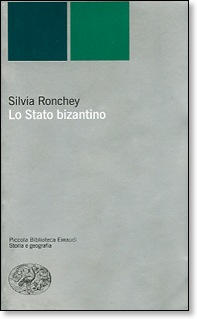
Ronchey, S. Lo Stato Bizantino. Turin: Einaudi, 2002.
This monograph, conceived as a university teaching text for Byzantine Civilisation courses and intended as an introduction to the topic for a learned general audience, has a dual objective: (1) to highlight the thousand-year Byzantine experiment in the history of statecraft and in the trajectory of geopolitics and (2) to introduce readers to Byzantium in a way that rescues the history of its civilisation from the common places of “byzantinism” and frees it from the tenacious ghosts of a thousand years of ideological denial. The characteristics of the Byzantine state are brought to light through an analysis of (a) its institutions in the first part (Time, Space, Economic Institutions), as well as by outlining (b) the evolution in the second part, in which the factual history of Byzantium emerges as the subtext of an analysis of the development of the ideology of autocratic power, Byzantine political thought and doctrine, imperial legislation and its social impact, mechanisms of selection and exchange among the elites, relations between the centre and the periphery and between church and state, economic trajectories, and the impact of nascent Western trade proto-capitalism. And, in conclusion, part three retraces (c) the afterlife, in which the history of the historiography on Byzantium intersects with the history of the influence and revival of the Byzantine political model between the 17th and 20th centuries, with particular attention to the debate within the Russian, then Soviet, economic-social school, to which A. P. Kazhdan’s historical thought derives from. The conception and cross-analyses of this brief history, dedicated to his memory, take their inspiration from his teachings.
The appendix to the introduction of the text, the Nota sull'italianizzazione dei nomi di famiglia dei Bizantini Eminenti, revisits briefly the problems the author grappled with at the time of writing Aristocrazia bizantina, co-authored with A. P. Kazhdan, and presents the empirical criteria adopted there: criteria dictated by grammatical considerations and common sense, and a desire to reconcile correct morphology and respect for the customs of the academic community, together with the need to simplify reading. As such, the Fondazione Lorenzo Valla officially adopted the criteria in Aristocrazia for Byzantine texts. In light of the consensus of the academic community, the author has adopted the same criteria in this volume.
REVIEWS
R. Nicosia in Mediterraneo antico 5.1 (2002), pp. 388-91.
A. Barbero in Storica 22 (2002), pp. 163-71.
M. Gallina in L’Indice dei libri del mese 11 (Novembre 2002), p. 27.
CITED BY
G. L. Coluccia, Basilio Bessarione: lo spirito greco e l’Occidente. Florence: Olschki, 2009, pp. XXI-XXII.
P. Schreiner in “Byzantinische Zeitschrift” 95 (2002), p. 801.
Keywords
- Byzantine civilisation
- Byzantine history
- Byzantine state
- Byzantine empire
- Geography of the Byzantine empire
- Byzantine economy
- Byzantine mode of production
- Byzantine statism
- Byzantine autocracy
- Byzantine political ideology
- Byzantine church
- Byzantine society
- Byzantine ruling class
- Byzantine city
- Byzantine countryside
- Byzantine imperial legislation
- History of Byzantine political thought
- History of the historiography on Byzantium
- Afterlife of Byzantium
- Italianisation of Byzantine family names