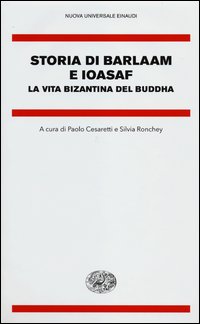
Ronchey, S. and P. Cesaretti, eds. Storia di Barlaam e Ioasaf. La vita bizantina del Buddha. Turin: Einaudi, 2012. [S. Ronchey, co-editorial oversight, incl. notes and Biblical apparatus, plus translation of the first part (pp. 3-148) and Introduzione: Il Buddha bizantino (pp. vii-cvii).]
The present volume re-introduces to an Italian audience the complete version of the Life of Barlaam and Ioasaph, published by the editors in 1980 (Vita bizantina di Barlaam e Ioasaf, Milan: Rusconi), now updated with the results of new research and of the critical edition by Robert Volk (De Gruyter, Berlin - New York 2009).
Original source of all of the Christianised stories of Buddha, this Byzantine text dating from the end of the 10th or beginning of the 11th century presents a genesis between the Caucasus and Mount Athos, in a web of different languages, cultures, and religions. The Barlaam and Ioasaph recounts the story of an Indian prince who, influenced by the teachings of an anchorite, flees the palace where his father has imprisoned him to protect him from the evils of the world, abandons his royal destiny, and sets off on his own mystical-hermetic journey. That the story mirrored that of the bodhisattva was recognised by scholars already at the end of the 19th century, but the various stages and mediations were unravelled only in recent years, thanks in large part to the critical edition published by Robert Volk between 2006 (vol. II) and 2009 (vol. I). Basing his work on Volk’s text and apparatuses, Paolo Cesaretti provides readers with a revision of the translation (by both editors) and of the notes and indices. In the introduction Silvia Ronchey provides exhaustive updated information on the entire work (Il Buddha bizantino, pp. vii-cvii). This effort marks a profound renewal of the two scholars’ 1980 edition. It is now possible to fully appreciate both the narrative qualities of the text and the allusive, philosophical richness of the various trajectories of the story, which have fascinated and influenced scores of writers over the centuries, from Jacopo da Varazze to Boccaccio, Shakespeare, and Tolstoy.
The co-translator’s and co-editor’s introductory essay (Il Buddha bizantino, pp. vii-cvii) traces in one hundred pages the first, albeit concise, historical-philological evaluation of the issue of the Barlaam and Ioasaph compiled in mind with the new critical edition by Robert Volk (Historia animae utilis de Barlaam et Ioasaph, I-II, Berlin – New York 2006-2009, which only now replaces the nineteenth century editio princeps by Jean François Boissonade) and, in particular, his monumental prolegomena (Einführung, ivi, vol. II). The introduction takes into account the crucial new research results present in the latter and, in general, which have emerged from the more than thirty years of research separating this new Italian edition from the first published by the two editors in 1980 (S. Ronchey and P. Cesaretti, eds., Vita bizantina di Barlaam e Ioasaf, Introduction, Notes, Biblical Repertory, Italian translation. Milan: Rusconi, 1980, 317 pp.). The essay sheds light on the evolution of the narrative nucleus from Eastern versions of the life of Buddha to the Georgian Christianisation, as well as to the formalisation, and authorial attribution of the Greek Byzantine narrative (for which Volk’s results are decisive), up until the success of the History of Barlaam and Ioasaph and its apologists in the modern age. All of the philological aspects touched on by Volk are analysed concisely and clarified as much as possible, with the addition of elements intentionally bypassed by Volk, such as those relating to Buddhist or Manichaean studies, or the reception of the text in the history of Medieval and modern literature or, eventually, the more general cultural and literary meaning of the work in the world of Byzantine civilisation and, more tangentially, in the context of post-iconoclast speculation and the so-called encyclopaedism of the 10th and 11th centuries. Therefore, the essay represents an overall introduction to the Barlaam and Ioasaph and its various aspects and the history of the scholarship surrounding it, as well as the enormous circumstances of its influence. What emerges is a “philological novel” that reveals how the study of textual tradition can touch the heart of cultural exchange and, in this case, the intricate relations between East and West.
REVIEWS
E. Fogliadini in Teologia 38/3 (2013), pp. 518-20.
T. Braccini in L'Indice 7/8 (2013), p. 20.
F. Rizzo Nervo in MEG 13 (2013), pp. 481-83.
Keywords
- Byzantine philology
- Byzantine literature
- History of scholarship
- History of influence and reception
- Byzantine hagiography
- History of Christianity
- History of religions
- Byzantine civilisation
- Byzantine history
- Byzantine theology
- Byzantine patristics
- Byzantine iconoclasm
- Barlaam and Ioasaph / Barlaam and Josaphat
- Byzantine Buddha
- St. Barlaam
- St. Ioasaph / Josaphat
- Byzantine encyclopaedism
- St. John Damascene / St. John of Damascus
- Euthymius of Iviron / the Hagiorite / the Athonite
- John Abulherit /of Iviron / the Athonite
- Robert Volk
- “prince-philosopher”