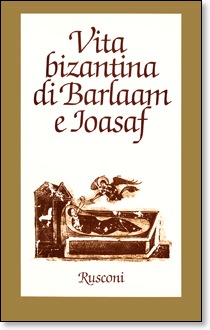
Ronchey, S. and P. Cesaretti, eds. Introduction, Notes, Biblical Repertory, Italian translation. Vita bizantina di Barlaam e Ioasaf. Milan: Rusconi, 1980.
The most important hagiographical folktale of the Eastern Middle Ages, Barlaam and Ioasaph, erroneously attributed to John Damascene and here presented in the first Italian edition of the Byzantine original, finds its origin in one of the most influential narrative nucleus in world literature. Ioasaf is the Buddha, but Barlaam and Ioasaph is much more than a Christian re-writing of the legend of Buddha; it is the story of a philosopher-prince, sacred to over twenty cultures in approximately thirty languages and ten different religions from Gibraltar to the Pacific, which owes its literary canonisation to Byzantium. A work whose date of composition has always been controversial, rich in oriental influences (from the original Indian to the Persian, Islamic, and Manichaean personifications) both in the development of the narration and in the ten fabulae interwoven in the plot, the story of the prince and the anchorite derives its character as a learned fable from the extraordinary grafting of ancient philosophical wisdom onto an exotic setting as splendid as it is dense with literary, and perhaps political, allusion. Enthusiastically received on its appearance, Barlaam and Ioasaph was first translated into Latin around 1050. Its subsequent reception and legendary influence are enormous, inspiring Rudolf von Ems and Gui de Cambrai, Shakespeare and Lope de Vega, Calderón, Hofmannsthal, and Tolstoy. Testimony of the greatness of Byzantine culture and its thousand-year vocation as mediator between East and West, this work would seem to offer the first refutation of the bias which would see Byzantine literature as arid and lacking in masterpieces.
Versione PDF
Keywords
- Byzantine philology
- Byzantine literature
- Byzantine hagiography
- History of Christianity
- History of religions
- Byzantine civilisation
- Barlaam and Ioasaph / Barlaam and Josaphat
- Byzantine Buddha
- St. Barlaam
- St. Ioasaph / Josaphat
- St. John Damascene / St. John of Damascus
- “prince-philosopher”
- Folktale
- Hagiographic folktale
- Vladimir Propp
- Morphology of the Folktale