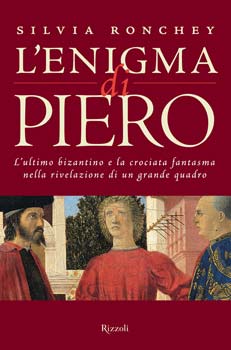
Ronchey, S. L\\\'enigma di Piero. L\\\'ultimo bizantino e la crociata fantasma nella rivelazione di un grande quadro. rev. ed. Milan: BUR, 2007.
Piero della Francesca’s Flagellation of Christ is one of the most enigmatic paintings in the history of Western art. Since its discovery in the Cathedral of Urbino sacristy in 1773, it has elicited persistent questions, not so much on the painter – it is conspicuously signed “Opus Petri de Burgo Sancti Sepulcri” — as on the subject represented. Who are the three characters in the foreground on the right? And what is their connection to the scene occupying the left side of the painting where two haughty characters in Oriental dress witness the flagellation of Christ from inside a mysterious building? Great critics from Longhi to Gombrich have tried to decipher the mystery in a variety of ways; but scholarly theories have always contradicted one another – often vehemently – without anyone’s ever managing to unravel completely the puzzling sequence of images in the small panel in Urbino.
An encyclopaedia would not be enough to outline the various interpretations of the Flagellation. The current interpretations can be divided into three categories. According to the current initiated by Roberto Longhi, the painting should be read as a celebration of the Montefeltro dynasty; in particular, as a commemoration of Duke Oddantonio, predecessor of Federico da Montefeltro, who possibly commissioned the work (the gentleman in brocade in the foreground at the far right of the panel), while Oddantonio himself, assassinated in a plot in 1444, could be identified with the blond youth at the centre of the trio. The other line of interpretation, supported by Gombrich, Bertelli and others, rejects a historical reading of the figures and leans toward allegorical readings connected to biblical exegesis and theological speculation.
Since the mid-twentieth century, a third, minority interpretation has instead associated the painting with the suffering of the Eastern Orthodox Christian Church, ‘flagellated’ by the Turkish advance, the predominant theme of the Legend of the True Cross, the cycle of frescoes by Piero in the Basilica of San Francesco at Arezzo. The painting’s relevance to the dominant event in the international politics of the time, Ottoman expansionism, and its connection to the tragedy of 1453, the fall of Constantinople to Mehmet II, were first proposed in the 1950s by Kenneth Clark. Later, in the mid-1970s, this insight was taken up again and brilliantly expanded on by Thalia Gouma-Peterson, whose famous essay essentially inspired Carlo Ginzburg’s still more famous Indagini su Piero.
Although more contested than accepted by the community of art historians as marked by internal contradictions, these last theories constitute the precedent for the ‘Byzantine’ reading put forth in L’enigma di Piero. First of all, they share an interpretation of the background of the painting. The secondary scene, i.e. the flagellation of Christ, in perspective in the background and from which the painting inaccurately takes its name in modern parlance, can be read as an idealised representation of Constantinople. The theatre in which the scene of the flagellation of Christ takes place is, in fact, characterised by the individual insignia of its founder, Constantine: the pillar Christ is tied to and the statue surmounting it allude to the famous pillar that once stood in the Forum of Constantine, topped by a gilt bronze statue of the first basileus in the guise of Apollo-Helios with a globe in his left hand and a lance in his right.
On the basis of this initial evidence, L’enigma di Piero proposes a first definition of the painting: the Urbino panel is “a double mise en abîme, the first spatial and temporal and the second metaphorical, carried out by Piero’s ‘ultimate weapon’, perspective” (Salvatore Settis). The main theme, placed in perspective in the foreground, is the three characters to the right, the figures in the proscenium, who are conversing in a given time and place. The topic of their conversation (the first mise en abîme) is what is taking place in the background, and that is, on the left side of the painting in perspective in the background: the violence perpetrated on Byzantium by the Turks, represented metaphorically (the second mise en abîme) by the flagellation of Christ, which, however, is not the main subject of the panel, but rather the secondary subject, so to speak, as the topic of the conversation placed in the foreground.
If the main subject matter of the painting — as also suggested by the writing “Convenerunt in unum” which used to be legible on the panel — is, therefore, the “conference” in the proscenium, its representation recalls, according to the theses of L’enigma di Piero, the Council of Florence of 1438-39, and the first of the three characters in the foreground is Bessarion, thirty years old at the time. According to L’enigma di Piero, the panel of Urbino was painted in 1458-59, exactly twenty years later, when Piero was working for Pius II at the papal court and the Piccolomini pope was about to inaugurate the great ecclesiastical kermesse on the Oriental question, updating and celebrating the Florence Council: the Council of Mantua in 1459.
The most important international political summit of the time would have brought together representatives of the Italian powers and the Europeans states to organise a massive new and common response against the Turks, in defence of the surviving part of Byzantium, the Morea, the capital of which was the very same Mystras at whose court Bessarion studied and where his mentor and precursor in Renaissance Platonism, Georgius Gemistus Plethon, taught.
Here is where knowledge of Byzantine history and culture enters by necessity and, so to speak, by force in the historical and artistic discourse. The new reading of the Flagellation of Christ offered by L’enigma di Piero, placing itself in the tradition of the third line of interpretation proposed by Clark, Gouma-Peterson, and Ginsburg, shifts the angle of vision, at this point, and focuses on the viewpoint of Byzantium. If the painting is understood as a veritable political-religious manifesto that, by celebrating on the occasion of the Council of Mantua in 1459 the Council held in Florence exactly twenty years before, renews the call to international anti-Turk mobilisation, its placement in the very blind spot that marks the borderlines between medieval and modern ages, between the fall of Constantinople and the discovery of America, obscured its readability for centuries to come.
After all, at the foundation of research in Byzantine studies is the recognition that an enormous lacuna exists in the self-representation of the European past caused by the geopolitical erasure and ideological denial of the huge role played by the Eastern Roman-Byzantine empire since the 15th century. The meaning of the Flagellation of Christ, which would have been very clear to contemporary spectators to the great epochal upheavals referred to in the painting, was not deciphered in succeeding periods nor up to now because until today knowledge of the “Eastern half of the sky” (André Chastel) that was the Byzantine horizon has been missing not only in art history, but also in European historiography. Apart from the stereotypes of “never-ending decline”, what has been lacking has been the factual knowledge of the history of the dominant Roman-Christian empire in the Middle Ages, without which no event in European history, and therefore, no artistic episode or visual message contained within the extremes of its birth and death, can really be explained.
According to the methodological hypothesis of L’enigma di Piero, the readability of the Flagellation of Christ is dependent, then, on as detailed and clear a reconstruction — in an intentionally plain style and genre between essay and narrative — of the complex East-West political theatre of the 1400s, of the real stakes created by the vacillating imperial title of Byzantium, of the intricate weave of strategic political, religious, cultural, and dynastic alliances that, over the middle decades of the 15th century, animated the last desperate attempts by the pro-Western Byzantine intelligentsia to save Byzantium, and thus the Roman-Christian empire, from the consequences of Islamic expansionism. A far-reaching project destined to fail that was not foreseeable when Piero painted the Flagellation of Christ. A plan conceived and tenaciously pursued by great statesmen and enlightened intellectuals, the leader of whom was and would remain until his death, Bessarion. And to whom, perhaps, the little panel of Urbino belonged.
RECENSIONI:
Silvia Pedone in Jurnal fur Kunstgeschichte (1 novembre 2007)
Keywords
- Piero della Francesca
- Flagellation of Christ
- Urbino
- Federico da Montefeltro
- Johann David Passavant
- Sir Charles Eastlake
- Bessarion
- “Save Byzantium in the West”
- Manuel II Palaiologos
- Oddone Colonna/Martin V
- Aeneas Silvius Piccolomini/Pius II
- Nicholas of Cusa
- Basilica of Sant’Andrea della Valle
- Council of Mantua
- Council of Ferrara-Florence
- John XI Bekkos
- Georgius Gemistus Plethon
- Niccolò III d’Este
- Benozzo Gozzoli
- Cavalcade of the Magi
- Pisanello
- Maria Comnena of Trebizond
- Cleopa Malatesta
- Sigismondo Pandolfo Malatesta
- Mystras
- “mummy of Mystras”
- Maurice Barrès
- Jean-Alexandre Buchon
- Theodore II Palaiologos
- Thomas Palaiologos
- Sophia of Monferrato
- Sophia Palaiologina
- Ivan III Vasilyevich of Moscow/Ivan the Great
- Moscow
- Constantinople
- Third Rome
- New Rome
- Mehmet II
- Fall of Constantinople
- Conquest of Constantinople